You choose forklift tires by matching the rubber compound, load capacity, and tread design to your specific facility floor and operational intensity. Selecting the wrong set of tires leads to immediate drivetrain strain and dangerous blowouts during peak shifts. This mistake doesn’t just cost money; it halts your entire production line and risks operator safety in high-traffic zones. By understanding the core forklift tire types , you can optimize fleet performance and drastically reduce maintenance expenses.
How do you perform a visual quality inspection?
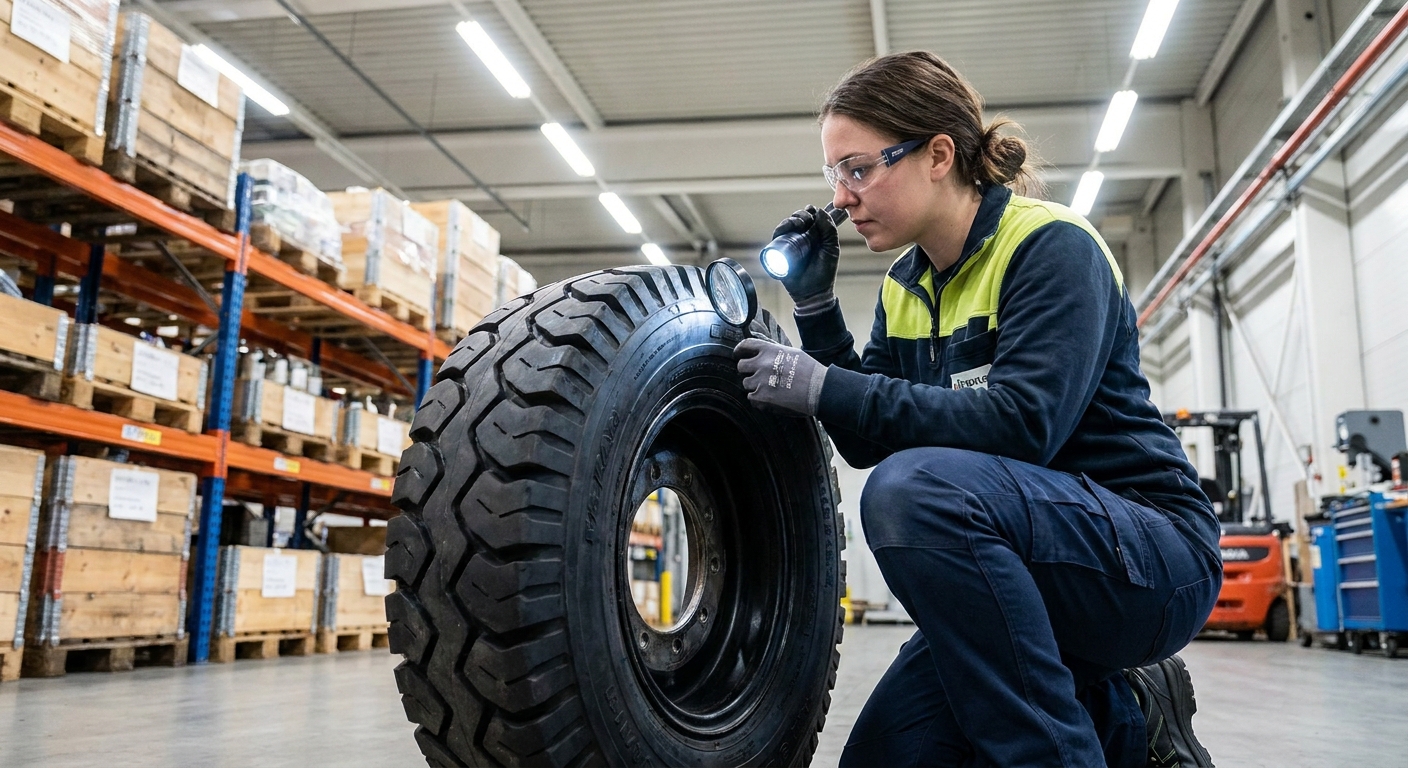
A thorough visual check is the first line of defense against substandard forklift tire types that might fail under pressure. Inspecting the surface for “bubbles,” deep cracks, or inconsistent textures helps identify poor bonding between internal rubber layers. These defects often indicate the use of recycled rubber that lacks the structural integrity required for heavy lifting.
Professional inspectors always look for sharp, clean edges on the tread and sidewall branding to verify high manufacturing standards. Excessive rubber “flashing” or off-center patterns are red flags for aged equipment or low-quality production. Catching these issues before mounting prevents costly downtime and keeps your forklift fleet moving safely.
What surface defects should you look for on the sidewall?
Look at this: sidewall integrity is non-negotiable for industrial safety. You should search for any signs of separation or uneven bulging that could lead to a sudden blowout.
- Check for deep weather cracking.
- Identify “bubbles” or air pockets.
- Verify smooth rubber texture.
Here is the deal: visual defects are often the result of improper storage or cheap raw materials that cannot handle the friction of daily use.
How can you identify poor structural irregularities?
Check this out: structural symmetry is essential for maintaining a level load during high-lift operations in your warehouse. A tire that is lopsided or has an uneven footprint will cause the forklift to sway dangerously.
- Observe the tread alignment carefully.
- Look for consistent color across the surface.
- Scan for sharp mold finish lines.
But wait, there is more: irregularities in the mold often point to a manufacturer that cuts corners on quality control protocols.
Key Takeaway: Always reject tires with visible sidewall bubbles or asymmetrical tread patterns to ensure basic operational safety.
| Inspection Factor | Quality Indicator | Red Flag | |
|---|---|---|---|
| Sidewall | Smooth, uniform finish | Bubbles, deep cracks | |
| Tread | Sharp, clear edges | Excessive flashing, off-center | |
| Rubber Bond | Seamless transitions | Visible layer separation |
Visual integrity serves as a primary filter to ensure only high-standard components enter your facility’s maintenance cycle.
Why is verifying exact tire dimensions critical?
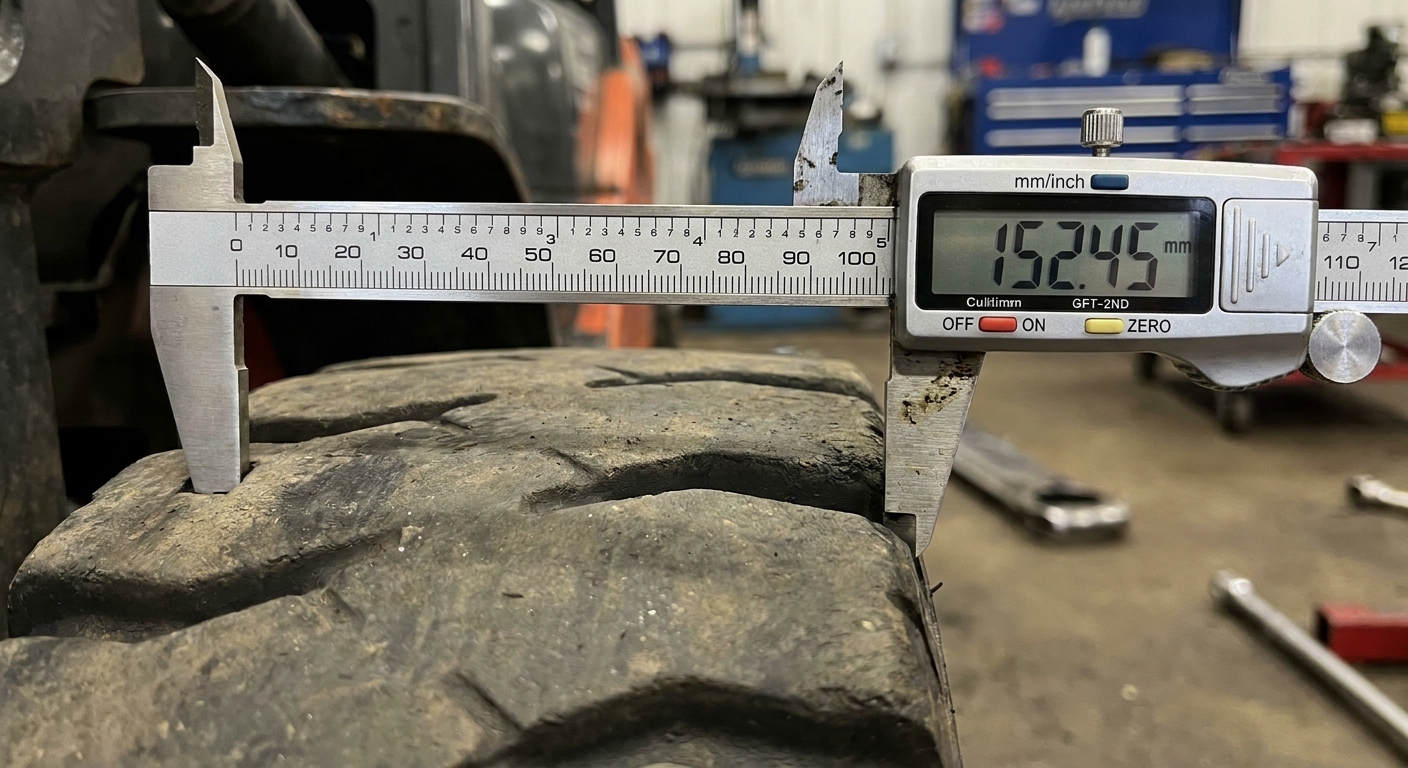
Verifying dimensions ensures proper rim fitment and prevents the tire from slipping or overheating because of technical mismatches. Even minor deviations in various forklift tire types can lead to clearance issues within the wheel well or uneven load distribution. Industrial calipers must be used to cross-reference the section width and outer diameter against the machine’s OEM specifications.
Incorrectly sized tires force the drivetrain to work harder, which significantly increases fuel or battery consumption. If the inner diameter is slightly off, the tire may slip under high torque, causing catastrophic heat buildup. You should always consult industrial forklift tires technical data sheets to confirm the exact measurements before purchasing.
How do you measure the section width accurately?
Listen to this: precise measurement requires industrial-grade tools rather than standard tape measures. You need to measure the widest part of the tire’s cross-section when it is properly inflated or mounted.
- Use digital industrial calipers.
- Measure across the sidewalls.
- Avoid measuring the tread only.
The bottom line is: even a few millimeters of difference can affect how the tire sits on the rim during heavy turns.
What happens if the tire rim fitment is slightly off?
Here is the deal: a loose fit between the tire and the rim creates friction that destroys the internal bead of the rubber. This leads to the tire spinning independently of the wheel, which eliminates your braking and acceleration control.
- Monitor for rim-slip marks.
- Check for heat discoloration on metal.
- Listen for unusual squeaking sounds.
But wait, there is more: poor fitment is a leading cause of premature tire failure in high-intensity logistics yards.
Key Takeaway: Use industrial calipers to verify dimensions, as even small size discrepancies can lead to dangerous rim slippage and mechanical strain.
| Dimension Metric | Purpose | Failure Risk | |
|---|---|---|---|
| Outer Diameter | Travel speed/torque efficiency | Clearances/gear wear | |
| Section Width | Load distribution | Sidewall rubbing | |
| Inner Diameter | Rim fitment security | High-torque slippage |
Accurate dimensional verification is the only way to guarantee that your equipment operates within its designed safety and efficiency parameters.
Does tire weight affect forklift stability?
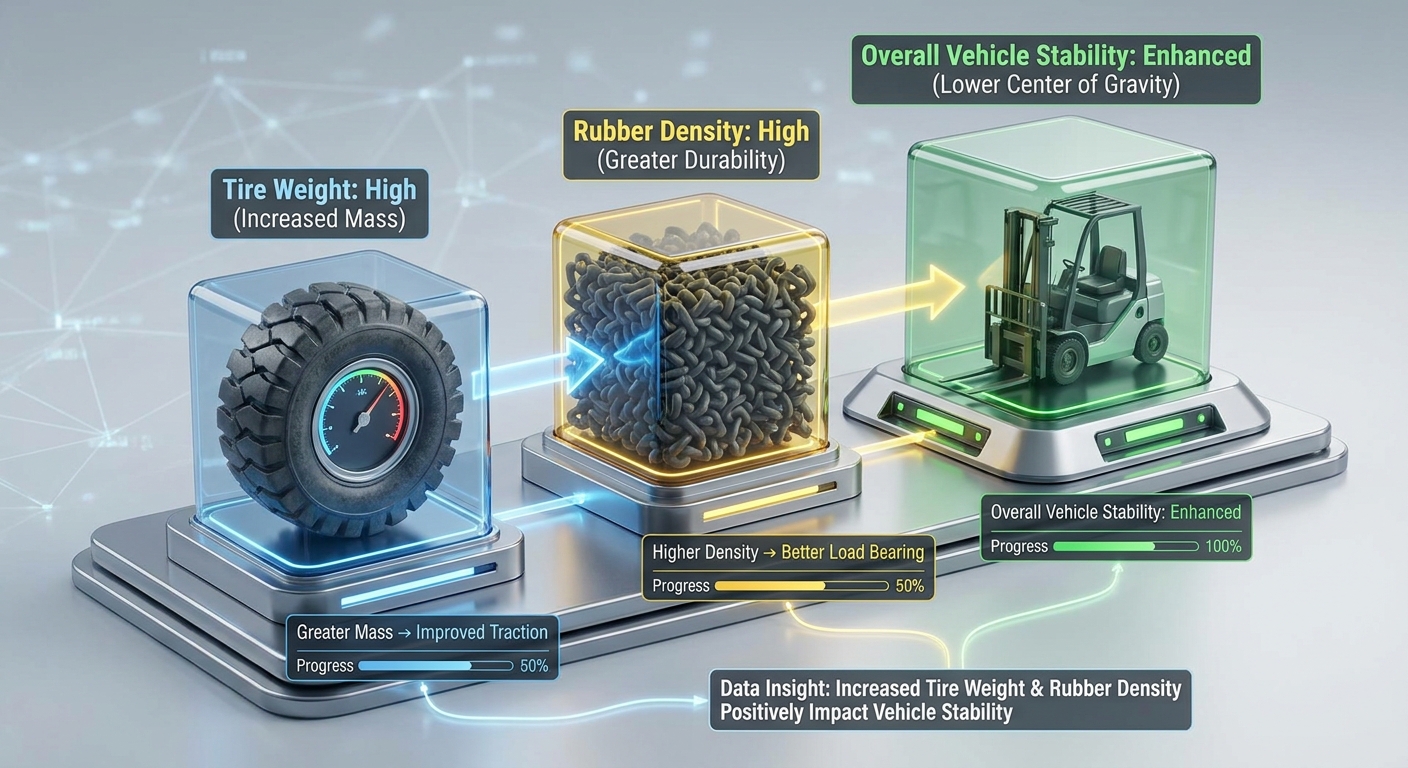
Increased tire weight typically indicates a higher natural rubber density, which directly enhances the vehicle’s center of gravity. When comparing different forklift tire types , a heavier tire usually offers better puncture resistance and a more stable platform for high-lift tasks. Density is a reliable proxy for material quality, suggesting the presence of robust internal reinforcements and premium compounds.
Lighter tires often contain more synthetic fillers and fewer internal plys, making them prone to “sway” when the mast is fully extended. This lack of mass reduces the forklift’s ability to absorb shocks from uneven floors or debris. Choosing a denser tire ensures your operators feel confident and secure while navigating tight warehouse corners with maximum loads.
Does a heavier tire always mean better durability?
Think about this: mass is generally proportional to the amount of actual rubber used in the manufacturing process. A heavy tire provides a thicker wear layer, allowing for more hours of operation before reaching the replacement line.
- Compare weights of same-size models.
- Look for high natural rubber content.
- Assess the thickness of the sidewall.
The fact is: cheaper tires often feel “hollow” or light because they lack the necessary internal density to resist crushing loads.
How does rubber density affect the vehicle center of gravity?
Here is the story: tires act as the foundation of your forklift’s entire weight-bearing system. High-density rubber adds “ballast” to the wheels, which keeps the machine planted firmly on the ground during rapid maneuvers.
- Reduces mast swaying at height.
- Improves traction on slick floors.
- Minimizes bouncing on rough joints.
Look at this: the extra weight provides a safety margin that is essential when handling off-center or oversized pallet loads.
Key Takeaway: Prioritize heavier tires because higher rubber density improves the forklift’s center of gravity and extends the total service life.
| Feature | High Density | Low Density | |
|---|---|---|---|
| Stability | Enhanced ballast effect | Increased mast sway | |
| Wear Life | Extended service hours | Rapid tread loss | |
| Puncture Risk | High resistance | Easily damaged |
Tire weight serves as a critical indicator of structural quality, providing the physical foundation necessary for safe and productive lifting.
What role does rubber hardness play in tire life?
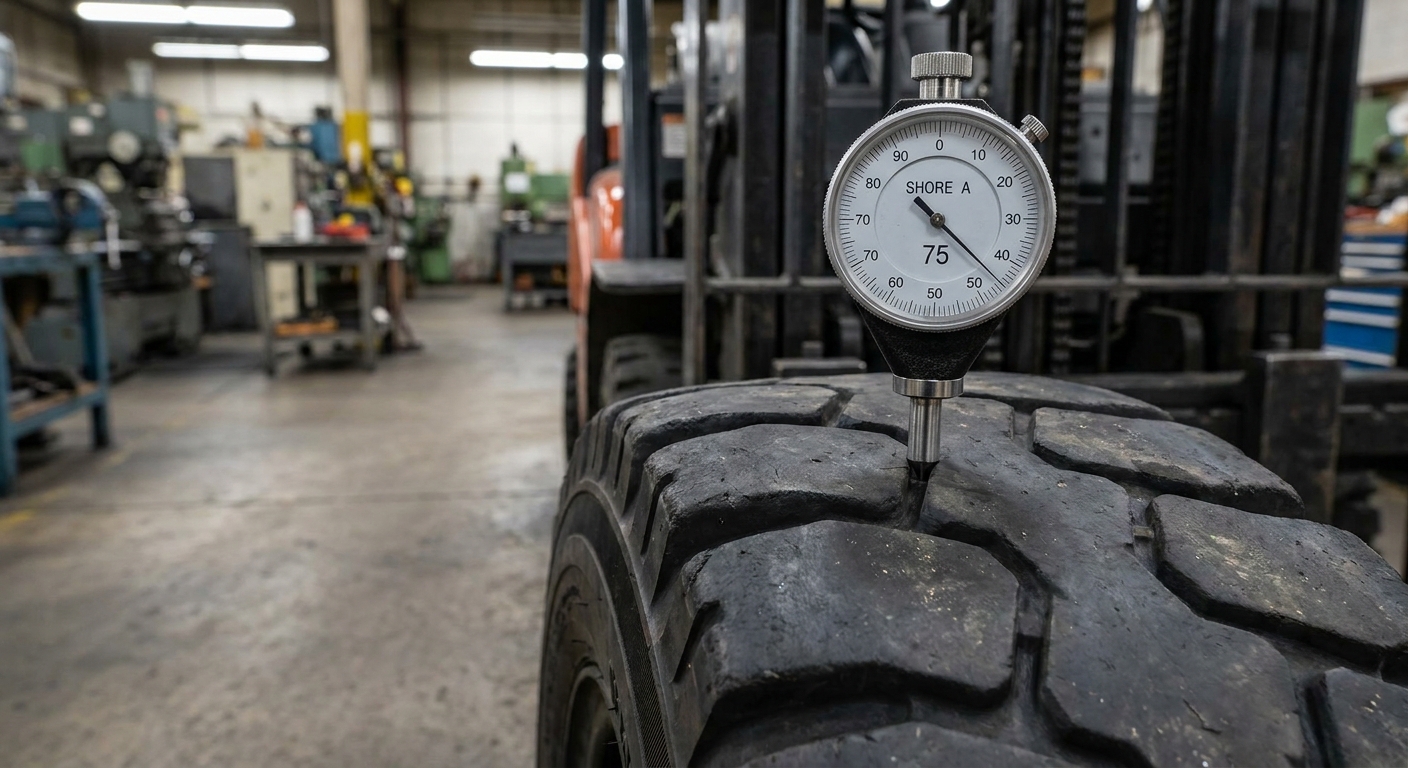
Rubber hardness, measured on the Shore A scale, determines the delicate balance between grip and wear resistance in forklift tire types. A tire that is too soft will provide excellent traction but will wear down rapidly on abrasive concrete surfaces. Conversely, a tire that is too hard may last a long time but will struggle with grip on ramps or wet warehouse floors.
You should use a durometer to verify that the tire meets the specific hardness requirements for your operating environment. For indoor warehouses, a medium-hard compound is often preferred to prevent floor marking while maintaining structural stability. Ensuring the correct hardness prevents the rubber from “chunking” or tearing under the immense pressure of heavy industrial loads.
How do you use a Durometer to test quality?
Look at this: testing hardness takes only a few seconds but can save you thousands in replacement costs. You simply press the needle of the durometer into the tread to get an immediate Shore A reading.
- Test multiple spots on the tread.
- Check for consistency across the tire.
- Verify against manufacturer specs.
The reality is: inconsistent hardness readings across a single tire indicate poor mixing of the rubber compound at the factory.
Is a harder compound always better for high-intensity work?
Here is the deal: hardness helps with wear, but it can also lead to a “stiff” ride that increases vibration for the operator. While hard compounds resist heat better, they may lack the flexibility needed to maintain traction on polished or painted floors.
- Evaluate floor surface texture.
- Consider operator comfort levels.
- Assess the risk of floor marking.
But wait, there is more: many premium tires use a multi-layer design with a harder outer shell and a softer, shock-absorbing inner core.
Key Takeaway: Use a durometer to ensure the rubber hardness matches your floor type, balancing the need for traction with long-term wear resistance.
| Hardness Level | Best Use Case | Primary Drawback | |
|---|---|---|---|
| Soft Compound | Cold storage/slick floors | Rapid wear/floor marks | |
| Medium Compound | Standard indoor warehouse | General purpose balance | |
| Hard Compound | High-heat/outdoor asphalt | Reduced grip on ramps |
Understanding the Shore A hardness of your tires allows you to customize the performance of your fleet to the specific challenges of your facility.
Which tire type fits your operating environment?
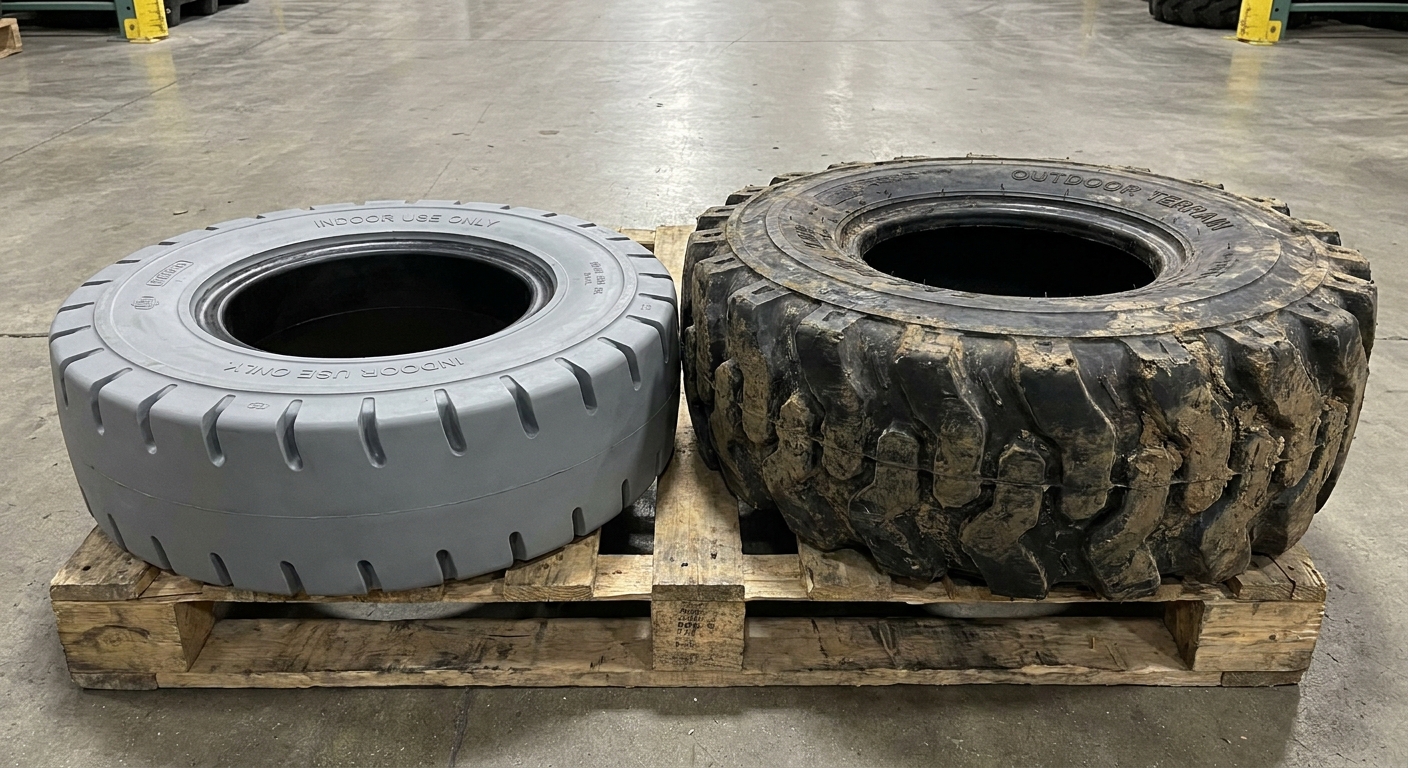
Selecting between solid resilient and pneumatic forklift tire types depends entirely on the terrain and the puncture risks in your facility. Solid tires are the industry standard for indoor operations where debris like nails, wood scraps, or metal shavings can cause flats. For outdoor yards with gravel or uneven dirt, pneumatic tires provide the necessary shock absorption to protect the forklift’s axle and load.
If your warehouse has polished concrete floors, you might consider non-marking tires to keep the facility looking professional. However, for extreme outdoor environments or heavy construction sites, you may need to look into OTR tire options that offer massive lugs and reinforced sidewalls. Matching the tire to the terrain is the most effective way to maximize your equipment’s uptime.
When should you choose solid tires over pneumatic?
Check this out: solid tires are virtually indestructible and eliminate the need for air pressure maintenance. They are perfect for 24/7 operations where a flat tire would mean an immediate and costly halt to production.
- Use in nail-heavy environments.
- Choose for high-lift stability.
- Select for minimal maintenance.
The bottom line: while they offer a rougher ride, the reliability of solid rubber is unmatched in standard warehouse settings.
Are pneumatic tires better for outdoor yard work?
Look at this: pneumatic tires act like a cushion for your forklift, absorbing the impact of potholes and rough transition strips. This protection extends the life of your steering components and prevents delicate loads from shifting during transport.
- Ideal for gravel and asphalt.
- Provides superior traction in rain.
- Offers a more comfortable ride.
Here is the deal: if you operate primarily outdoors, air-filled or foam-filled tires are essential for preventing mechanical fatigue on your machines.
Key Takeaway: Choose solid tires for puncture-prone indoor environments and pneumatic tires for outdoor terrain where shock absorption is required.
| Environment | Recommended Tire | Benefit | |
|---|---|---|---|
| Indoor Warehouse | Solid Resilient | Zero flats/High stability | |
| Outdoor Yard | Pneumatic | Shock absorption/Traction | |
| Clean Room | Non-Marking Solid | No floor scuffs |
By identifying the primary hazards of your work zone, you can select a tire type that minimizes maintenance and maximizes safety.
How do you calculate the required load capacity?
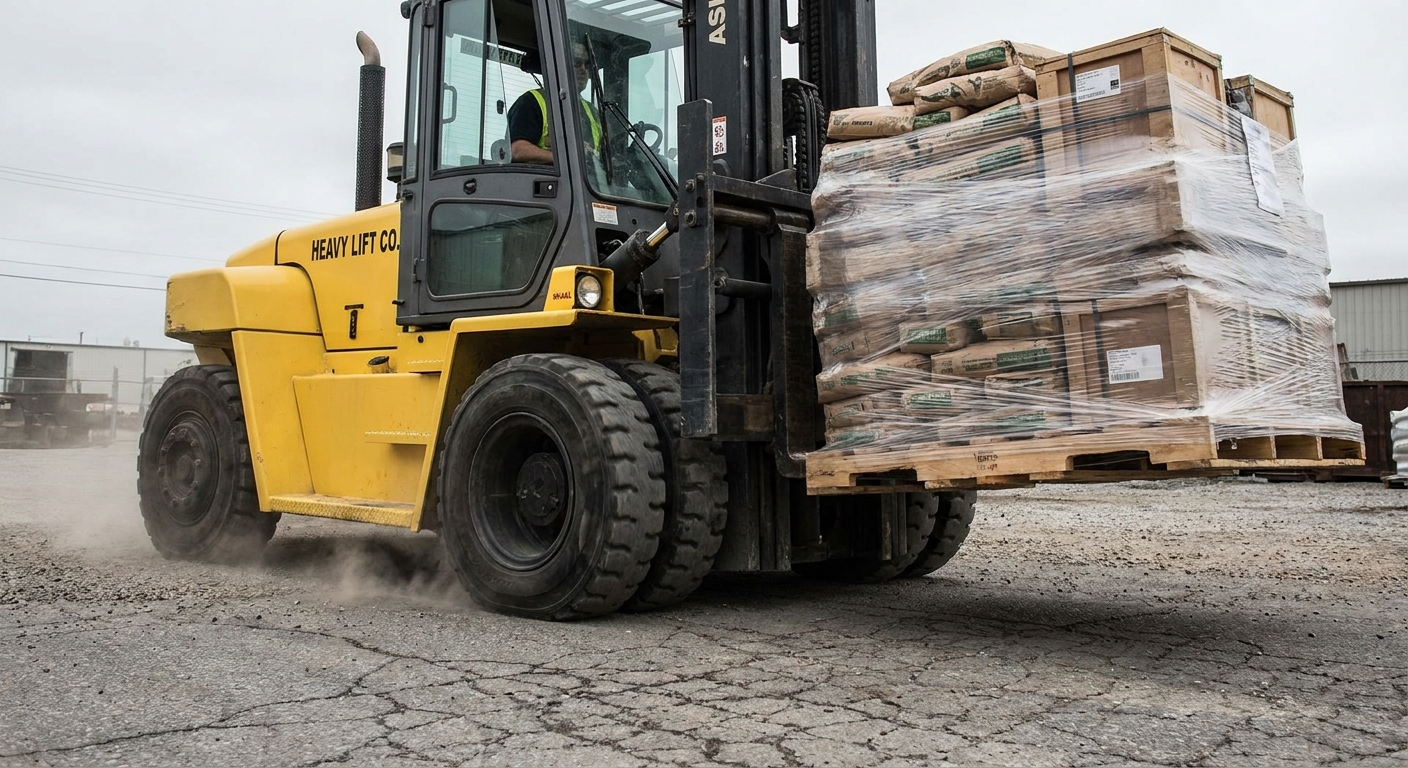
The tire must be rated to handle the forklift’s total weight plus the maximum potential weight of the heaviest load. All forklift tire types have a specific load index that must never be exceeded, especially on the front axle. When the forks are loaded, the center of gravity shifts forward, putting immense pressure on the front tires which can lead to rapid failure if they are under-rated.
Professional procurement officers always apply a safety margin of 10-15% above the absolute minimum requirement. This extra capacity accounts for the dynamic forces generated during sudden stops or turns with a full load. Overloading a tire is the fastest way to trigger internal structural failure and dangerous blowouts that endanger everyone in the vicinity.
How does maximum lift capacity affect your choice?
Look at this: the rating on the side of your forklift refers to what the mast can lift, not what the tires can support. You must calculate the combined weight of the machine’s chassis, the battery, and the maximum payload together.
- Check the forklift data plate.
- Consult tire load index charts.
- Account for heavy attachments.
Here is the deal: adding an attachment like a paper roll clamp increases the front-end weight significantly, requiring a higher-rated tire.
What safety margins should be applied for multi-shift work?
Listen to this: heat is a byproduct of load, and multi-shift operations never give tires a chance to cool down. A tire running at its absolute limit 24 hours a day will fail much faster than one with a built-in safety margin.
- Use a 15% safety buffer.
- Consider heat-resistant compounds.
- Monitor for sidewall deformation.
But wait, there is more: selecting a tire with a higher load rating than necessary can actually lower your total cost of ownership by extending tire life.
Key Takeaway: Always select tires with a load capacity 10-15% higher than your maximum requirements to account for weight shifts and heat stress.
| Component | Weight Factor | Impact on Tire | |
|---|---|---|---|
| Forklift Chassis | Constant load | Baseline stress | |
| Maximum Payload | Dynamic load | Primary front-tire stress | |
| Attachments | Added leverage | Increased front-end pressure |
Proper load calculation is a non-negotiable safety step that prevents catastrophic tire failure during critical lifting operations.
Which tread design is best for your floor surface?
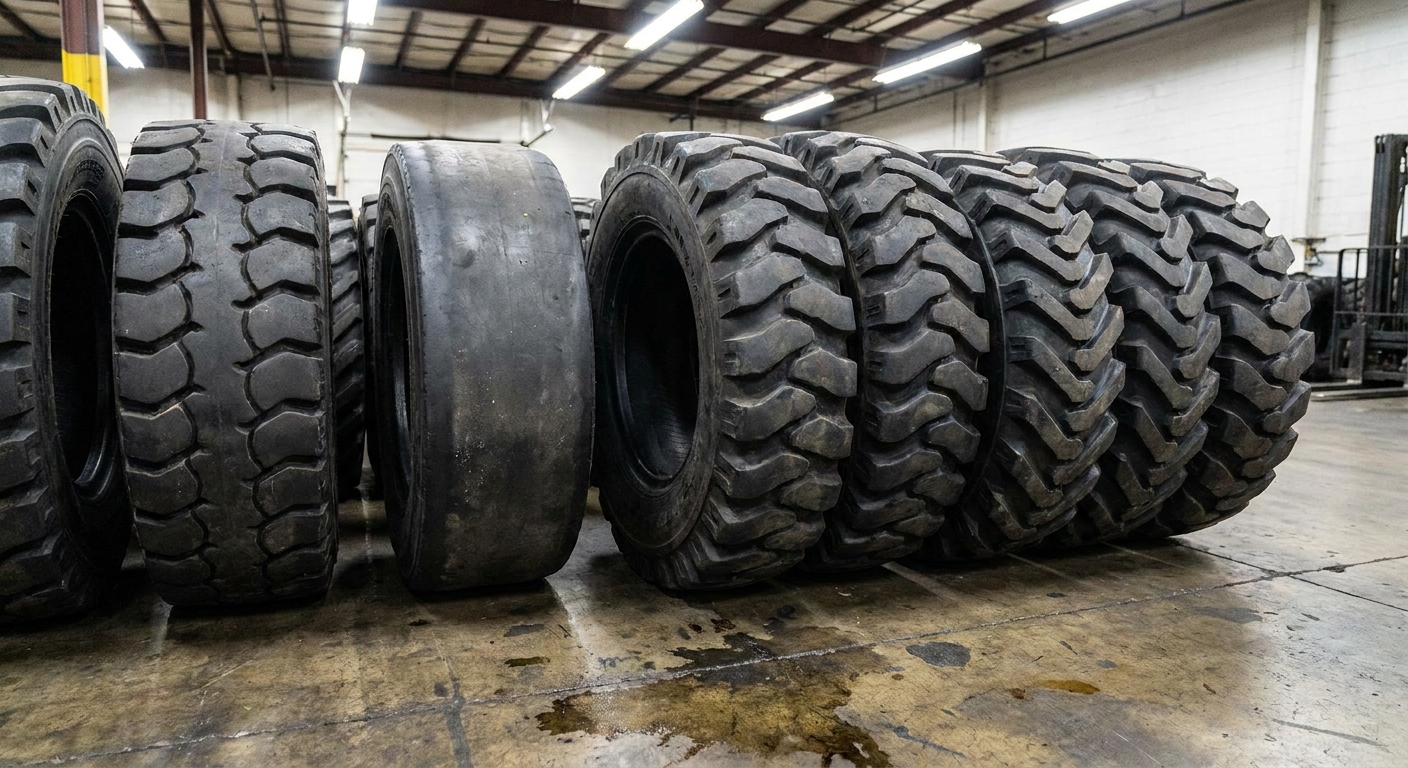
Tread patterns dictate how different forklift tire types interact with your facility’s floor to provide braking and cornering stability. Smooth or “slick” tires are often preferred for indoor electric forklifts on clean, dry concrete because they offer the largest contact patch. However, if your floors are frequently wet or have transition zones into outdoor areas, a lugged pattern is necessary to channel moisture and prevent hydroplaning.
Deep lug patterns are essential for any outdoor yard work where loose gravel, mud, or snow might be present. These patterns provide the “bite” needed to move heavy loads up ramps or across uneven terrain without losing traction. Choosing the right tread ensures that your operators maintain full control of the vehicle, regardless of the environmental conditions.
Do smooth tires provide better traction on dry docks?
Check this out: on a perfectly dry, smooth floor, a slick tire actually has more “grip” because more rubber is touching the ground. This maximizes stability and allows for precise maneuvering in very tight warehouse aisles.
- Best for electric indoor trucks.
- Provides the smoothest ride.
- Minimizes floor vibration.
The fact is: smooth tires wear more evenly and typically last longer than lugged tires when used strictly on flat, indoor surfaces.
How do lug patterns perform on uneven outdoor terrain?
Look at this: lugged tires are designed to act like claws, digging into soft or loose surfaces to provide forward momentum. Without these lugs, a forklift will simply spin its wheels when trying to cross a patch of mud or wet gravel.
- Essential for rain and snow.
- Improves braking on ramps.
- Self-cleans debris from tread.
But wait, there is more: lugged tires can cause more vibration on smooth floors, which might lead to faster wear of the forklift’s steering components over time.
Key Takeaway: Use smooth tires for maximum stability on dry indoor floors and lugged treads for outdoor traction and wet surface safety.
| Floor Condition | Recommended Tread | Key Benefit | |
|---|---|---|---|
| Dry Polished Concrete | Smooth (Slick) | Maximum contact/Stability | |
| Wet/Oily Floors | Grooved/Siped | Moisture channeling | |
| Gravel/Dirt Yard | Deep Lug | High traction/Digging power |
Selecting the correct tread design is an easy way to improve the safety and handling characteristics of your entire forklift fleet.
How do you manage heat buildup in high-intensity shifts?
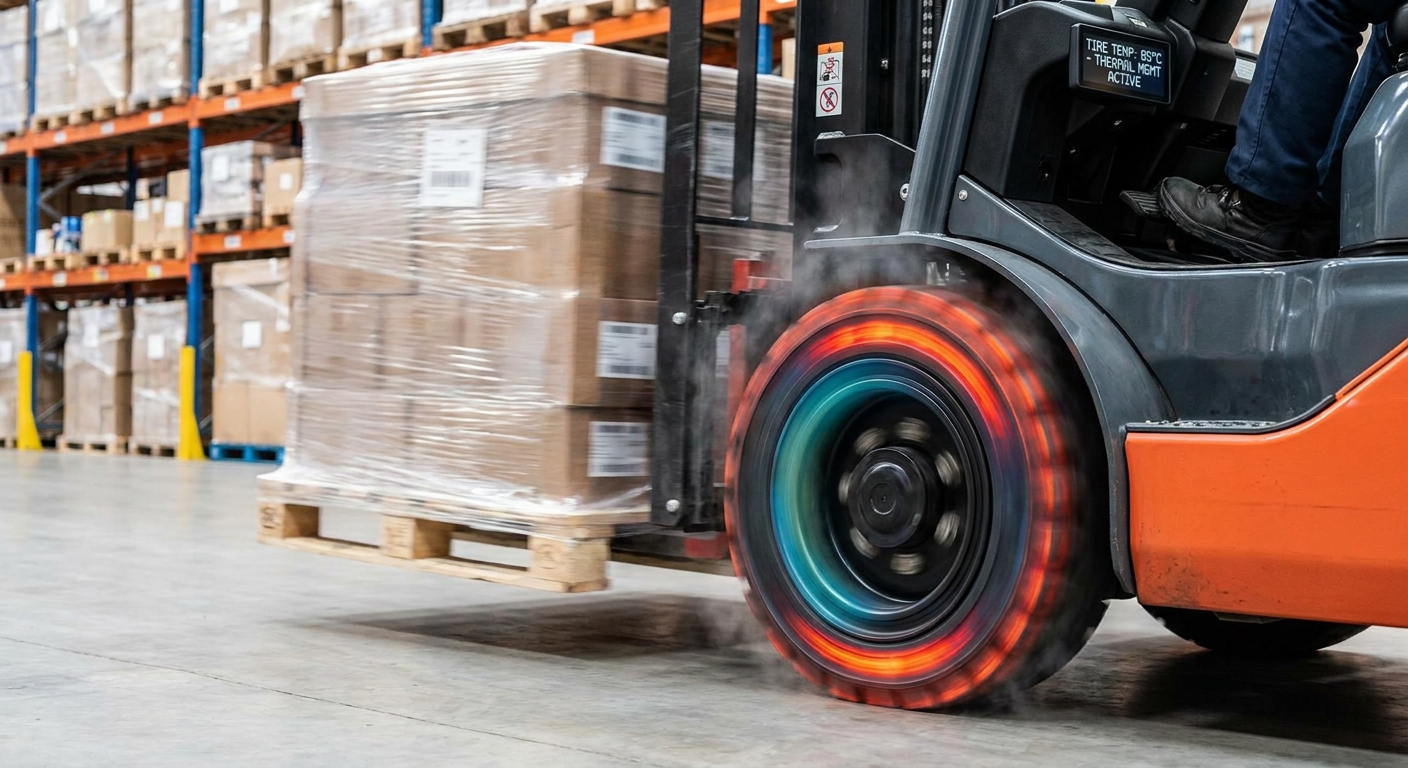
Heat is the primary enemy of solid rubber forklift tire types, especially in high-speed or long-distance applications. When a forklift travels long distances without stopping, the internal temperature of the rubber can rise until the chemical bonds begin to break down. This process, known as liquefication, can cause the tire to fall apart from the inside out, often without any warning.
To manage this, you must choose tires with “cool-running” center compounds that are designed to dissipate heat quickly. Some applications may even require you to switch to different specialized tires, similar to how tractor tires are designed for specific thermal loads. Monitoring your duty cycles and ensuring the tires have time to cool between long runs is vital for preventing internal failure.
Why is heat dissipation vital for multi-shift operations?
Look at this: in a 24-hour facility, tires never have the chance to reach ambient temperature. This cumulative heat buildup weakens the rubber, making it much more susceptible to “chunking” and sidewall failure.
- Reduces risk of internal melting.
- Extends life of the rubber bond.
- Prevents sudden structural collapse.
Here is the deal: premium tires use advanced chemistry to pull heat away from the core and release it through the sidewalls.
What compounds offer the best thermal resistance?
Check this out: many high-performance tires feature a three-stage construction with a dedicated thermal-management layer in the middle. This layer is engineered to be more flexible, reducing the friction that generates heat during every rotation of the wheel.
- Look for “cool-runner” labels.
- Verify natural rubber content.
- Use larger tires for better cooling.
But wait, there is more: traveling at high speeds while empty can actually generate more heat than traveling slowly with a heavy load.
Key Takeaway: For high-intensity shifts, always invest in premium three-stage tires with specialized cool-running compounds to prevent internal heat failure.
| Shift Intensity | Tire Requirement | Risk of Neglect | |
|---|---|---|---|
| Low (1 shift/day) | Standard Solid | Minimal heat issues | |
| Medium (2 shifts/day) | Dual-Compound | Accelerated wear | |
| High (3 shifts/day) | Triple-Stage Cool | Internal liquefication |
Effective heat management is the secret to getting the maximum possible hours out of your industrial tire investment.
What safety certifications should you look for?
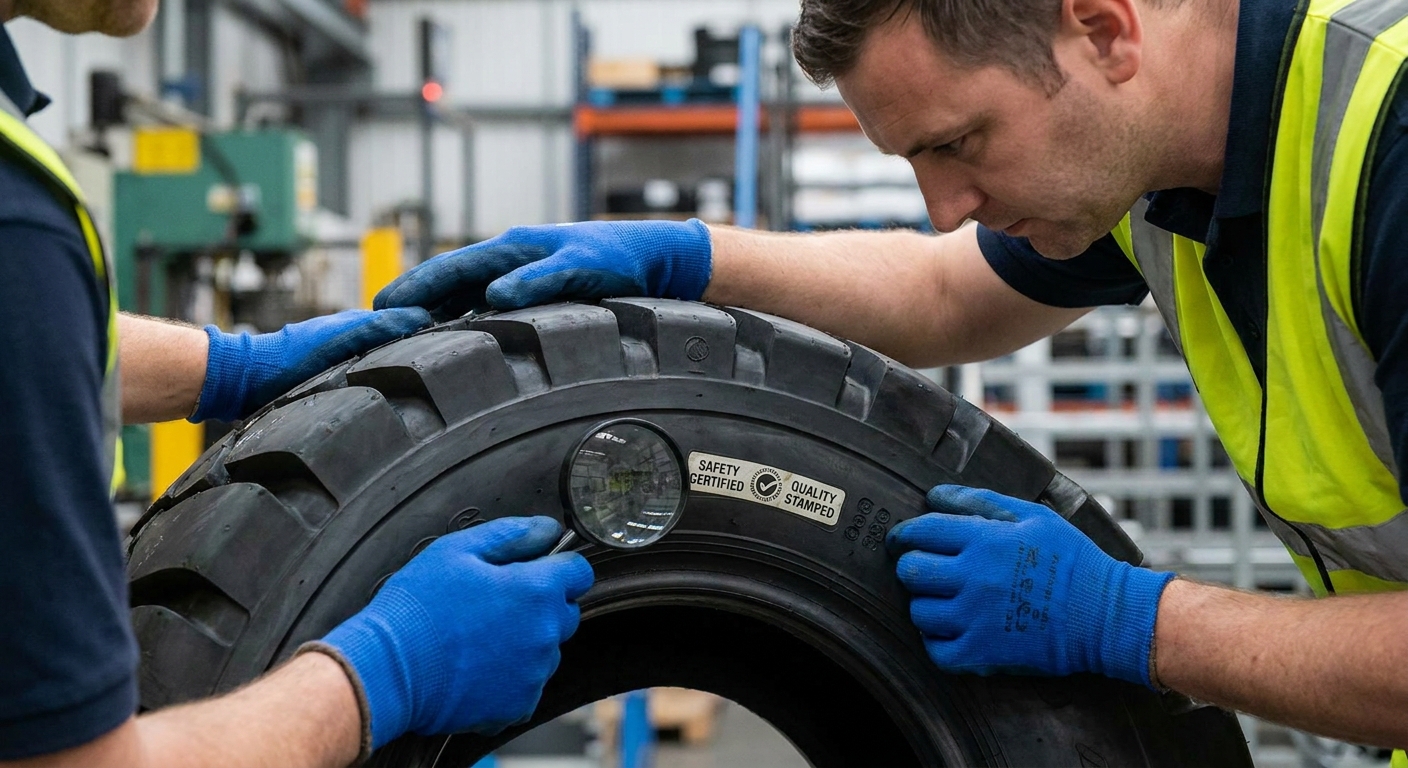
Certifications provide independent proof that your forklift tire types have been manufactured under strict quality control protocols. You should always look for ISO 9001 certification, which ensures that the factory follows consistent management and production standards. Additionally, look for specific load and speed index certifications that guarantee the tires have been tested to meet their advertised performance ratings.
Pre-Shipment Inspections (PSI) are another critical layer of security for bulk buyers. A PSI report confirms that the specific batch of tires you are receiving has been measured for dimensional accuracy and rubber hardness before it leaves the factory. This documentation gives you peace of mind that every tire in your shipment is ready for heavy-duty service in your facility.
Are ISO 9001 standards enough for industrial tires?
Check this out: ISO 9001 is a great start, but it only covers the management process. You also need to look for specific product certifications like REACH compliance, which ensures the rubber compounds are free from hazardous chemicals.
- Look for international safety marks.
- Verify load-testing certificates.
- Ask for rubber chemical analysis.
The bottom line is: certified tires are less likely to contain “fillers” that compromise safety to save on manufacturing costs.
How do PSI reports guarantee quality for importers?
Look at this: a Pre-Shipment Inspection acts as your eyes and ears on the factory floor. The inspector checks a random sample from your order to ensure the dimensions, weight, and hardness all match your requirements.
- Prevents shipping of defective batches.
- Confirms quantity and packaging.
- Provides photographic evidence of quality.
But wait, there is more: receiving a PSI report before the container leaves the dock is the best way to avoid expensive returns or safety disputes later.
Key Takeaway: Only purchase tires from manufacturers that provide ISO certification and comprehensive Pre-Shipment Inspection (PSI) documentation.
| Certification | What it Proves | Why it Matters | |
|---|---|---|---|
| ISO 9001 | Process consistency | Predictable product quality | |
| Load/Speed Index | Structural testing | Prevents overloading failure | |
| REACH/SGS | Material safety | Environment/Operator health |
Strict adherence to certification standards protects your business from the hidden risks of substandard industrial components.
When is the right time to replace your forklift tires?
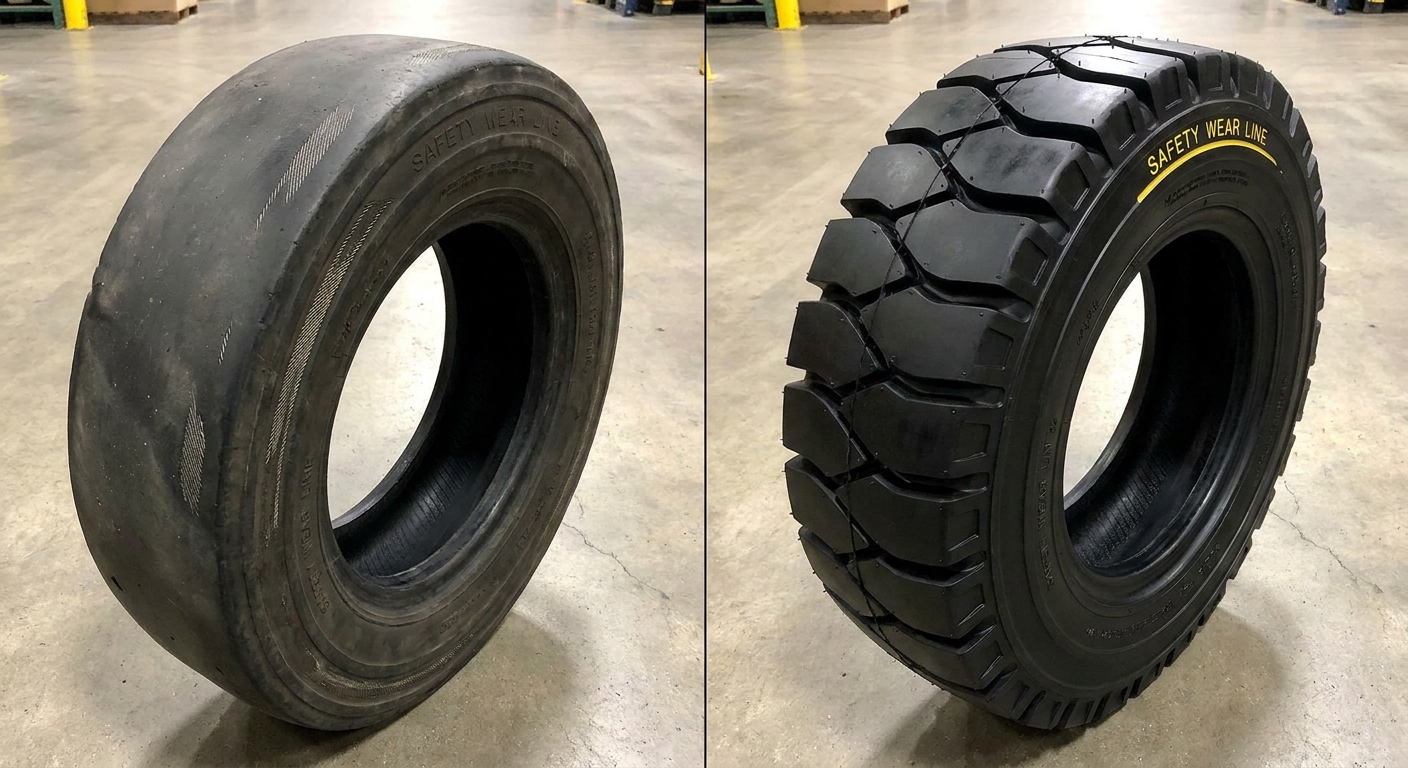
Operating on worn-out forklift tire types increases vehicle vibration, which can damage the forklift’s axle and cause significant operator fatigue. Most professional tires feature a “60J line” or a built-in wear indicator located on the sidewall. Once the rubber has worn down to this mark, the tire has lost its ability to safely dissipate heat and support the rated load.
Continuing to run on “balding” tires is a major safety risk that leads to loss of traction and reduced braking efficiency. Furthermore, as the rubber gets thinner, the risk of a catastrophic failure from debris impact increases dramatically. Regular inspections should be part of your daily pre-shift routine to ensure your fleet is always running on safe rubber.
How do you identify the safety wear line?
Look at this: the wear line is a clear physical marker that tells you exactly when the tire’s useful life has ended. You should never wait until the tread is completely gone to schedule a replacement.
- Locate the “60J” mark on the sidewall.
- Check the “Safety Wear Line” text.
- Measure the remaining rubber depth.
Here is the deal: once you hit that line, the tire no longer has the internal volume to handle the heat of a full shift.
What are the risks of operating on “balding” tires?
Check this out: bald tires turn your forklift into a 10,000-pound sliding hazard on smooth warehouse floors. They lose their ability to grip the ground during an emergency stop, which can lead to collisions with racking or personnel.
- Increased stopping distances.
- Higher risk of “chunking” out.
- Severe mechanical vibration damage.
But wait, there is more: the vibration from worn tires is a leading cause of back pain and long-term injury for forklift operators.
Key Takeaway: Replace tires immediately when they reach the safety wear line to prevent mechanical damage and maintain emergency braking performance.
| Wear Level | Action Required | Operating Risk | |
|---|---|---|---|
| New to 50% | Routine daily checks | Low risk | |
| 50% to Wear Line | Order replacement stock | Increasing heat/vibration | |
| Past Wear Line | Immediate replacement | High failure/Safety hazard |
Staying ahead of the replacement cycle is the most cost-effective way to protect your equipment and your employees.
Conclusion
Choosing the right forklift tires is an essential business decision that impacts safety, productivity, and your bottom line. By following a rigorous selection process—focusing on visual quality, precise dimensions, and environmental suitability—you can ensure your fleet remains operational and efficient. Remember that investing in premium compounds and verified certifications always pays off through longer service life and reduced maintenance costs. If you need expert guidance or a detailed quote for your next fleet upgrade, please contact us to speak with a professional consultant who can help you optimize your industrial tire strategy.
Frequently Asked Questions
Can I use smooth tires in an outdoor loading dock?Generally no, because smooth tires lack the grooves necessary to channel water and provide traction on wet or uneven asphalt. You will experience dangerous slipping and reduced braking power during rain or snow.
What is the best way to prevent forklift tires from flat spotting?Avoid leaving a fully loaded forklift parked for extended periods, as the constant pressure on one spot can permanently deform the rubber. Moving the machine or unloading it at the end of every shift is the best preventative measure.
Can I mix different tire brands on the same forklift axle?No, you should never mix brands or wear levels on the same axle because it causes uneven load distribution and unstable handling. Always replace tires in pairs to maintain the machine’s balance and steering geometry.
What is the best tire type for a cold storage facility?Soft-compound non-marking tires are usually the best choice for cold storage because they maintain flexibility and grip in freezing temperatures. Harder compounds can become brittle and lose all traction on ice-covered concrete.
Can I press my own forklift tires in-house?Yes, but only if you have a professional-grade hydraulic tire press and the correct cage safety equipment to prevent injury. Most companies find it safer and more efficient to use a mobile pressing service to ensure perfect rim alignment.